Posts

Interoperability to Nothing?

Image
Up until now, the Philippine Navy is way far behind its south-east Asian counterpart in as far as naval assets are concerned. Currently, it is merely operating three Ex-US coastguard cutters armed with 76 mm cannons and two cargo vessels from Indonesia which were recently added to handle its transport needs, it goes without saying, that the Philippine Navy is unarmed and ill-equipped by world standard. What does that mean? It means, and barring political reasons, no matter what it does, at its present and near future state, it will not be able to fulfill its constitutional mandate, of protecting the Philippine sovereign territory and its sovereign rights. Although two frigates are under construction at the behest of the Philippine's Department of National Defense, its specifications, particularly its weapons payload will make it just a bit more threatening than the Ex-US coastguard cutters, but not enough to instill fear in the heart of any foreign adversary. It will be lightly ar...

What is that animal called Federalism?

Will it finally tame the voracious Filipino politicians or will it suck the remaining bond that adheres the Filipinos to one flag? Much has been told about Federalism while the process is being shoved to the Filipino's soring throat. A few have attempted to interpellate its effect on society as a whole, and down the line to the ordinary Juan de la Cruz, but they seemed to be out of focus. Federalism is essentially a departure from the unitary system, wherein government power is centralized. Federalism is basically a form of government that allows power sharing among the states created with the federal government. Each state will have its own legislature, judiciary, and executive component, independent and separate from that of the Federal government. So much so that each state can enact its own laws, impose its own taxes, maintain its own police force and army as the case may be. It can formulate its own economic agenda and policies, execute them to the extent that it will be bene...

Can an elected president declare a revolutionary government?

To answer the foregoing question, one has to dissect the impersonality of an elected president. An elected president was enthroned to power, by the majority of the constituency, under the rules and laws governing the electoral process. The powers bestowed upon an elected president, by the majority of the voting population is subject to the fulfillment of certain duties and obligations defined in the related laws, and by the constitution itself. The latter is the document, that manifest the agreement between the electorate and the elect. Upon being sworn into office, the elected president commits himself to fulfill the mandate, enshrined in the constitution and the appropriate laws and binds himself to uphold and enforce the same. It is under the foregoing conditions that his authority achieves validity. Such authority is in effect ministerial, and incumbent upon his position. It is an authority delegated by the people, limited by the terms and conditions inherent within the charter. A...

Venezuela and the Petrodollar

Venezuela's decision to abandon the petrodollar is a necessity. Every sovereign nation has the right to chart its own course. Premise given, the US sanctions against Venezuela is an act of war. Venezuela 's action to abandon the petrodollar that has rendered its currency to worthlessness. is a desperate act of self-defense, mainly to preserve what is left. It is a question of survival. It is not about China, people have rights no matter what their leanings are, to eat and survive. The currency basket is not limited to US Dollars. There are the Euros, the Sterling, the Yen, and recently the Renmimbi. Selling its oil other than the Us Dollar could theoretical help in alleviating its present situation. Why then the US and possibly the west hates Venezuela, it is because Venezuela won't sell their oil at a price dictated by the west and on top of that, Venezuela charges 16 percent royalties from the previous 1 percent for its oil since the nationalization of its oil industry. ...

The Willing Prey

History is a cycle; it perpetuates itself time and again, capitalizing on human weakness and the gullibility of the uninformed and the misinformed. It is akin to a hammer that persistently pounds on an unmoving nail till it sink way over its head. Imperialism, Hegemony, and Colonization are old cliché, and they always refer to one thing... Dominance. The imperialist of the modern times find it less costly to employ soft power to achieve control and dominance, and that what OBOR is all about. China ’s One Belt, One Road (OBOR) initiative will be the modern equivalent of China ’s Silk Road , established more than 2000 years ago. The Silk Road was a web of trade routes that had connected China to the countries in the Middle East, and certain parts of Asia .  Its sole objective then was to market Chinese Silk beyond its border. The OBOR on the other hand, is partly and similarly aimed, to create a network of infrastructures like roads, railways, roads, pipelines, and utility gri...

Ten Naval Carriers for the Philippine Navy?

Image
It’s not improbable, in fact, it’s possible and doable. In about three years the Philippine Navy may be able to possess a number of naval carriers as arsenal ships or as platforms for anti-ship missiles, surface-to-air missiles, Long Range Multiple Launch Rocket System (LR-MLRS) and helicopters, if and only if, the Philippine Navy, and the government at large, will abandon the tenets of orthodoxy and traditionalism in the procurement of military assets. Hence, in the process of reinventing itself, it may find prudence and the practicality, of using the hulls and superstructures of five to ten years old merchant ships, available for sale in the world market. The size and dimension of which, may depend on its intended purpose. The Strategic Sea Lift Vessels (SSV) procured from Indonesia ’s PT PAL had cost the Armed Forces roughly around US$ 160 million; both SSV has an average length of 123 meters. The equivalent amount of money which may be allotted for future SSV may largely be use...

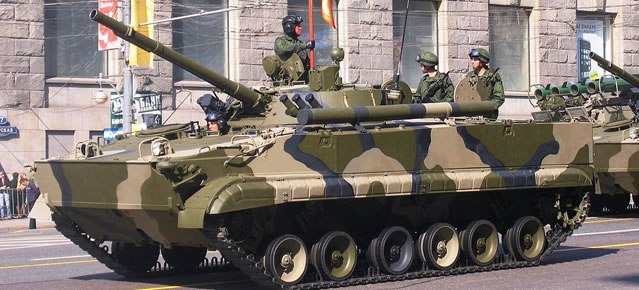
Why Russia’s BMP3 Infantry Fighting Vehicle is the best option for the Armed Forces of the Philippines (AFP).

Image
Any avenue of approach in a war zone is a kill zone, be it an urban pave-ways or rural settings. The AFP have been sustaining unusually high casualties, resultant of inadequate armor and fire support. Individual infantry men were fully exposed while in marches on unfamiliar terrain towards the insurgent’s lair. Military vehicles have to traverse enemy territories without the security of protective armor (metal plates, chopped tree-trunks mounted on side of vehicles, sand bags, etc.).  Corollary, essential intelligence can easily be obtained in advance through aerial reconnaissance even before convoys proceed towards its destination. While the latter can be provided by available and inexpensive technology like drones, its utilization had remained an exception rather than the rule. Insurgent’s stationery bunkers/ fortifications greatly offset the AFP’s numerical advantage, that otherwise can easily be eliminated by an explosive blast. Sniper behind hard cover, like the inside of bui...